

Importing Prefab Homes from China: The Complete Guide
How the supply chain works, what it costs, how to vet a manufacturer, and why factory-direct changes everything
Ten years ago, importing a prefab home from China was a fringe decision — the territory of adventurous developers willing to navigate an opaque supply chain for the sake of cost savings. In 2026, it’s mainstream. The quality gap between Chinese factory production and Western alternatives has closed to the point where the decision to import is no longer primarily about cost — it’s about access to manufacturing capability, supply chain integration, and lead times that domestic builders simply cannot match.
But the market is not homogeneous. China’s prefab industry spans everything from ISO-certified aluminium-frame manufacturers building to ANSI and DOT standards, to Alibaba trading companies reselling units they never touch. The difference between a good import experience and a bad one comes down almost entirely to which type of supplier you engage — and most buyers don’t know how to tell them apart before it’s too late.
This guide covers the full import process: why China’s manufacturing advantage is real and durable, how to distinguish a manufacturer from a trading company, what certifications matter for US buyers, how shipping and customs work, and what the total landed cost actually looks like. It also explains the factory-direct model Magic Box operates — and why it removes most of the risks buyers face when importing through intermediaries. For the broader context of how a factory-built home fits into the US market, see our factory-direct tiny house manufacturer guide.
Why China Leads in Prefab Home Manufacturing
China’s dominance in prefab housing manufacturing is not accidental — it’s the product of three decades of supply chain development, infrastructure investment, and specialisation that no other market has replicated at scale.
Integrated supply chains
The most significant manufacturing advantage China holds is vertical integration. A Chinese prefab home factory like Magic Box’s Yantai facility can source aluminium extrusions, insulation panels, windows, electrical components, plumbing fittings, and interior finishes from suppliers within the same industrial cluster — often within a 200km radius. This eliminates the procurement friction, price volatility, and lead time variability that Western manufacturers face when sourcing components from multiple domestic and international suppliers. The result is more predictable build timelines and lower material costs.
Precision manufacturing equipment
Modern Chinese prefab factories operate CNC cutting machines, laser fabrication equipment, and automated assembly jigs that produce components to sub-millimetre tolerances. Magic Box’s laser-cut 6063 aluminium frame components are a direct product of this manufacturing capability — the precision that allows dimensionally identical frames unit after unit, which is what enables consistent window seals, panel fits, and assembly quality. This level of precision is available in Western manufacturing, but at a cost premium that makes it uneconomical for volume production of homes at the price points the market demands.
Cost structure
Labour costs in Chinese manufacturing remain significantly lower than in North America or Western Europe, though the gap has narrowed considerably over the past decade. More importantly, the combination of lower labour costs, integrated supply chains, and high-volume production creates a total cost structure that allows Chinese manufacturers to produce homes at 40–60% of the equivalent US factory-built cost — while meeting international quality standards. This is not a quality compromise; it’s a structural manufacturing cost advantage.
Export infrastructure
China’s port infrastructure is the most developed in the world for manufactured goods export. Container shipping from major Chinese ports to US West Coast ports runs on established schedules with predictable transit times. The logistics infrastructure — freight forwarders, customs brokers, shipping lines — is mature and competitive. For a buyer importing a prefab home, this means more shipping options, better rates, and more reliable transit times than any other export origin.
Manufacturer vs. Trading Company: Why It Matters More Than Anything Else
The single most consequential decision in sourcing a prefab home from China is whether you’re dealing with the actual manufacturer or a trading company acting as an intermediary. Many buyers don’t discover which one they’re dealing with until something goes wrong — at which point the trading company has no ability to resolve the issue because they don’t control the factory.
| Factor | Direct Manufacturer | Trading Company |
|---|---|---|
| Owns the factory | Yes — can visit, inspect, verify | No — middleman between buyer and factory |
| Customisation ability | Direct design modifications possible | Limited — passes requests to factory; slow |
| Quality control | Accountable — QC happens in their facility | Limited — often no inspection access |
| Price | Factory price — no middleman margin | Factory price + 15–25% trading margin |
| Problem resolution | Direct — can address issues at source | Indirect — blame often deflected to factory |
| Certifications | Held by the manufacturer, verifiable | May be borrowed, outdated, or fabricated |
| Production timeline | Factory-controlled — predictable | Dependent on factory priority; variable |
The challenge is that trading companies deliberately present themselves as manufacturers. They use language like “our factory,” show photos of manufacturing facilities they don’t own, and list certifications they can’t actually substantiate. The only reliable way to verify manufacturer status is to request the business licence (营业执照) showing manufacturing scope, ask for the factory address and cross-reference it against the company registration, and — ideally — conduct or commission a factory visit before placing an order.
How to Vet a Chinese Prefab Manufacturer
Vetting a Chinese manufacturer before committing to a purchase requires a structured approach. The following steps are what professional developers and experienced importers use — and what Magic Box makes straightforward by being a verified manufacturer with an open-door factory visit policy.
Certifications That Matter for US Buyers
Certifications serve two purposes in the import context: they verify that the product was built to a defined standard, and they unlock specific benefits (financing access, titling, insurance) in the destination market. Not all certifications are equal, and some that sound important have limited practical relevance for US buyers.
Essential
Essential
Important
Useful
EU Only
Permanent Only
For US buyers purchasing a THOW, the certification priority is clear: ANSI A119.5 and DOT approval unlock financing, titling, and legal towing — the three things that determine whether the purchase works practically. Everything else is secondary. Review the full financing implications in our tiny house financing guide.
Shipping: FCL, LCL, and What It Actually Costs
Ocean freight is the primary shipping method for prefab homes from China to the US, Australia, Europe, and most international destinations. Understanding the difference between FCL and LCL shipping, and how each applies to prefab home shipments, is essential for accurate budget planning.
FCL (Full Container Load)
A full container load means your shipment occupies an entire shipping container — either a standard 20-foot container (approximately 33 cubic metres of cargo space) or a 40-foot container (approximately 67 cubic metres). For most Magic Box THOW models, the home ships as a fully assembled unit on its trailer inside a 40-foot high-cube container, or is towed as an oversized load via roll-on/roll-off (RoRo) shipping. FCL is the preferred method because it keeps the unit protected during transit and simplifies customs clearance — one container, one shipment, one set of documentation.
FCL rates from Chinese ports to US West Coast ports (Los Angeles, Long Beach) typically run $3,000–$6,000 for a 40-foot container in 2026, depending on route, carrier, and market conditions. Transit time is approximately 14–21 days to the West Coast, 25–35 days to the East Coast.
LCL (Less than Container Load)
LCL consolidates multiple smaller shipments into a shared container. For panelized tiny house kits — where the home ships as flat-packed components rather than an assembled unit — LCL can reduce shipping costs significantly for smaller models. Magic Box’s MagicNest panelized series uses an optimised LCL-compatible crating system (ISTA 3A certified) with an all-in freight and clearance cost of approximately $3,000 to the US West Coast for a single unit. This represents a 35–50% logistics cost saving versus full container shipping for the same unit.
RoRo (Roll-on/Roll-off)
THOWs that are too tall to fit inside a standard container (most units with a roof height above approximately 9.5 feet) can ship via RoRo — driven onto the ship’s vehicle deck and secured for the voyage. RoRo exposes the home to marine air (salt spray, humidity) during transit, which is a consideration for any components that aren’t aluminium or stainless. Magic Box coordinates RoRo shipping for models where it’s the most practical option, with protective wrapping as standard during transit.
What shipping costs include (and don’t include)
Ocean freight quotes typically cover the carrier’s charge from the Chinese port to the destination port. They do not include: origin inland transport (factory to port), export customs clearance in China, destination port handling fees (typically $300–$800), customs broker fees at the destination ($500–$1,500), import duties (calculated separately — see next section), and final delivery from the destination port to your site. Budget all of these when calculating total landed cost.
US Customs, Import Duties, and HTS Codes
Importing a prefab home into the United States involves US Customs and Border Protection (CBP) processing, classification under the Harmonized Tariff Schedule (HTS), and payment of any applicable import duties. This is not as complex as it sounds when you have a customs broker and correct documentation — but getting the HTS classification wrong creates delays and unexpected duty bills.
HTS classification for prefab homes
Prefab homes and their components are classified under Chapter 94 of the HTS (“Furniture; Bedding, Mattresses; … Prefabricated Buildings”). The relevant heading for a complete prefabricated building or dwelling unit is typically HTS 9406, with duty rates that vary by material and structure type. Panelized components may be classified under different headings depending on the material — aluminium structural components under Chapter 76, insulated panels under Chapter 39 or 73. An experienced customs broker who handles building products or manufactured homes will classify correctly the first time; a general broker may misclassify and trigger a CBP query.
Section 301 tariffs and current duty rates
Products imported from China are subject to Section 301 tariffs in addition to the standard MFN (Most Favoured Nation) duty rates. As of 2026, prefabricated buildings under HTS 9406 from China carry duties that should be verified with your customs broker at the time of purchase — tariff rates have been subject to ongoing policy review and can change. Magic Box’s logistics team provides buyers with the current duty rate estimate for their specific shipment as part of the quotation process, so there are no surprises at customs.
Required documentation for import clearance
A complete import file for a prefab home shipment requires: commercial invoice (describing the goods, their value, and the parties involved), packing list (detailed contents of the shipment), bill of lading (proof of shipment), certificate of origin (confirming Chinese manufacture), and any applicable product certifications (ANSI A119.5 certificate, ISO 9001 certificate). Missing or incorrectly completed documents are the primary cause of customs delays — typically adding 5–15 business days to port clearance.
Using a licensed customs broker
Using a licensed US customs broker (a CHB — Customs House Broker, licensed by CBP) is not legally required for all imports, but it is effectively essential for prefab home imports due to the complexity of classification and the value of the shipment. Broker fees typically run $500–$1,500 for a single shipment. The broker prepares and submits the entry documentation, communicates with CBP on your behalf, arranges payment of duties and taxes, and coordinates release and delivery. Do not attempt to self-clear a prefab home shipment without prior import experience.
Total Landed Cost: What Buyers Actually Pay
The factory price of a prefab home from China is not the price you pay. The total landed cost — what it takes to have the home sitting on your site, ready for hookup — includes a range of additional costs that buyers frequently underestimate. Here’s how to build an accurate budget.
| Cost Component | Typical Range (US) | Notes |
|---|---|---|
| Factory price (FOB) | Varies by model | Free On Board — includes manufacture and loading at Chinese port |
| Ocean freight (FCL 40ft) | $3,000 – $6,000 | China to US West Coast; East Coast add $1,000–$2,000 |
| Marine insurance | 0.3–0.5% of cargo value | Strongly recommended; covers loss/damage in transit |
| Destination port charges | $300 – $800 | Terminal handling, container release |
| Customs broker fees | $500 – $1,500 | Entry preparation, CBP filing, duty payment coordination |
| Import duties (Section 301) | Verify current rate | Applied to declared customs value; confirm rate at time of order |
| Inland transport (port to site) | $500 – $3,000+ | Depends on distance from port; oversized load permits may apply |
| Site prep | $3,000 – $12,000 | Gravel pad, utility stub-outs, access route — see site prep guide |
When buying factory-direct from Magic Box, most of these components are quoted as part of the initial price discussion — you receive a clear picture of total delivered cost before committing. The factory price, ocean freight, and inland transport to your nearest major port are typically included in Magic Box’s delivered price quote. Duties, customs broker fees, and final site delivery are itemised separately so there’s full transparency.
Even with all these additions, the total landed cost of a Magic Box unit typically sits 30–50% below a comparable US-manufactured home — reflecting the structural manufacturing cost advantage described in Section 1. For a realistic cost breakdown by model, see our tiny house price guide.
The Factory-Direct Advantage: What It Means in Practice
Factory-direct purchasing eliminates the most significant risks in the China import process by removing the intermediaries who create them. Here’s what changes when you buy directly from the manufacturer.
No trading company margin
A trading company adds 15–25% to the factory price as its margin. On an $80,000 home, that’s $12,000–$20,000 that goes to the intermediary, not into the home. Buying factory-direct from Magic Box means that margin stays either in your pocket or gets redirected into a higher specification — better finishes, an off-grid solar package, or a more capable heating system. We’ve been factory-direct since 2015 and it’s a non-negotiable part of the model.
Direct quality control accountability
When you buy through a trading company, quality issues discovered at delivery often result in a circular blame game between the trading company and the factory. The trading company says the factory made an error; the factory says the specifications weren’t communicated correctly. When you buy factory-direct, there is one accountable party: Magic Box. Our quality team inspects every unit before it leaves the factory, produces a documented inspection report, and stands behind the product with a clear warranty.
Customisation with direct communication
Customising a prefab home through a trading company is a game of telephone: your spec goes from you to the trading company, gets translated (sometimes literally), and goes to the factory — where it may or may not be interpreted correctly. Buying factory-direct means your customisation requirements go directly to Magic Box’s design team, who can confirm feasibility, flag potential issues, and produce 3D renders of the modified design before production begins. Read how our panelised assembly process works in the panelized assembly guide.
Shipping to 60+ countries with established logistics
Magic Box has shipped to over 60 countries since 2015. That means we have established freight forwarder relationships, customs broker networks in major destination countries, and documented shipping procedures for most major markets. For buyers in Australia, Canada, the UK, continental Europe, and across Southeast Asia, we’ve shipped there before — we know what the customs documentation needs to look like, which carriers handle oversized loads correctly, and what the typical clearance timelines are. This institutional knowledge is worth far more than the initial cost savings of a seemingly cheaper option from an inexperienced exporter.
Frequently Asked Questions
Is it legal to import a prefab home from China into the US?
Yes — importing prefab homes from China into the US is legal and routinely done by individuals, developers, and resort operators. The import process involves standard CBP customs clearance, HTS classification, and payment of applicable duties. There are no import restrictions on prefab residential structures. The relevant compliance requirements are on the product side (ANSI A119.5 for THOWs, local building codes for permanent placement) rather than on the import process itself. Using a licensed customs broker ensures the paperwork is correctly completed and duties are properly assessed.
How long does the full process take from order to delivery?
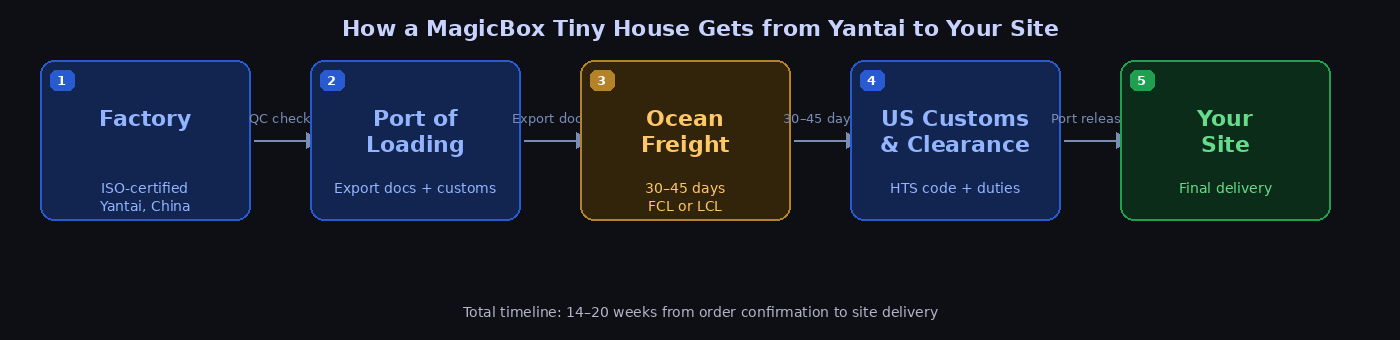
For a Magic Box order, the typical timeline breaks down as: 2–4 weeks for design finalisation and customisation sign-off, 30–60 days for factory production, 14–35 days for ocean transit (West Coast faster than East Coast), 5–15 business days for customs clearance, and 3–7 days for final inland transport to your site. Total end-to-end: 14–20 weeks from order confirmation to site delivery for most models. In-inventory units (when available) can ship within 7 days of order and arrive 6–8 weeks later. Contact Magic Box to check current inventory and production queue status.
What happens if the home is damaged in transit?
Marine insurance (cargo insurance covering the shipment from origin to destination) is the protection mechanism for transit damage. This is separate from the manufacturer’s warranty — the warranty covers manufacturing defects, not transit damage. Magic Box recommends all buyers obtain marine insurance on their shipment; we can coordinate this as part of the shipping arrangement. The coverage should be “all-risk” (covering physical damage from any cause) at the full declared value of the shipment. If damage is discovered on delivery, the process is: document the damage with photos immediately on inspection, notify the carrier and the insurance underwriter within the timeframes specified in the policy, and file a claim. Do not accept delivery without noting damage on the delivery receipt.
Can I visit Magic Box’s factory before ordering?
Yes — factory visits to Magic Box’s Yantai facility are welcomed and encouraged for serious buyers, particularly those placing multi-unit orders. Seeing the production facility, meeting the engineering team, and inspecting current production units in person provides the quality confidence that no specification sheet or video call can fully replicate. Contact our team to arrange a visit itinerary; we can also coordinate with buyers attending the Canton Fair or other Chinese trade events to add a factory visit to the same trip. For buyers who cannot visit, we can arrange a third-party inspection at any production stage.
Do I need a freight forwarder, or does Magic Box handle shipping?
When buying factory-direct from Magic Box, you do not need to independently arrange a freight forwarder — shipping coordination is included in our service. We handle freight booking, export documentation, and provide full tracking from the Yantai factory to your destination port. You will need a licensed customs broker at the destination country for import clearance (we can recommend brokers with prefab home experience in major markets). If you prefer to use your own freight forwarder, that’s also possible — we provide all the export documentation needed to hand off to your chosen forwarder at the Chinese port.
How does buying from Magic Box compare to sourcing through Alibaba?
Sourcing through Alibaba means independently vetting suppliers (most of whom are trading companies, not manufacturers), negotiating a contract without legal support, arranging your own quality inspections, coordinating your own freight and customs, and managing any quality disputes through a third party who doesn’t control the factory. Buying factory-direct from Magic Box means one accountable party from design through delivery, with established export processes, certifications already in place, and an 11-year track record of international shipments. The factory price on Alibaba may look lower — but once you add trading company margin, independent inspection costs, and the risk premium of an unvetted supplier, the comparison changes significantly. Our builder vetting guide lists the questions that expose the difference.
Skip the sourcing complexity — buy factory-direct
Magic Box has shipped to 60+ countries since 2015. We handle design, production, quality control, export documentation, and shipping coordination — you focus on your site and your plans. Browse models and pricing, or talk to our team about your specific country, use case, and delivery timeline.