

Tiny House Resort ROI: Why Developers Choose Modular Units
The global hospitality market is experiencing a seismic shift. Modern travelers are no longer satisfied with the sterile environment of traditional hotel corridors; they crave “experiential lodging.” This demand has created a massive opportunity for land developers to enter the glamping and outdoor resort market. However, the biggest hurdle remains the traditional construction model—it is too slow, too labor-intensive, and increasingly unpredictable. This is why savvy developers are turning to manufactured tiny homes to maximize their Return on Investment (ROI).
The Economics of Glamping: Low Investment, High Return
The financial allure of a tiny house resort lies in its lean capital expenditure (CapEx). When calculating the tiny home cost versus a traditional hotel room or a site-built luxury cabin, the modular approach offers a significant advantage. A high-quality Magic Box Tiny House provides a luxury guest experience at 40-60% less than the cost of permanent ground-up construction.
Beyond the initial purchase, the tiny home cost is further optimized by the mobility of the units. Because many of these structures are classified as temporary or transportable, they often qualify for accelerated depreciation in several tax jurisdictions. This allows developers to write off the asset much faster than a standard 30-year building, injecting vital cash flow back into the business during the critical early years of operation.
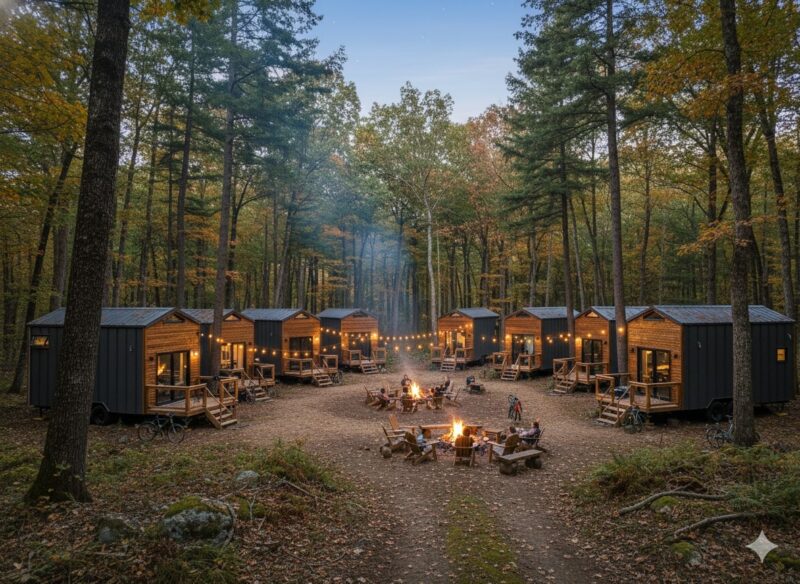
Speed to Market: Deploying 20 Units in 60 Days
In real estate development, “time to first dollar” is the most critical metric. Traditional construction for a 20-unit resort can easily take 18 months when you factor in weather delays, contractor shortages, and site inspections. By utilizing prefab building techniques, the timeline is compressed into a fraction of that time.
While your site team is grading roads and installing utility hookups, your units are being precision-built in a factory. This parallel workflow means that as soon as the pads are ready, the homes can be delivered and installed. Many manufactured tiny homes from Magic Box can be fully operational within 48 hours of arrival. This speed allows developers to capture seasonal revenue that would otherwise be lost to construction delays.
Durability of Factory-Built Homes for High-Frequency Rentals
Resort units face much higher wear and tear than private residences. A modular unit must be able to withstand weekly cleanings, high guest turnover, and diverse environmental conditions. Unlike traditional site-built homes, prefab building units are engineered to be structurally rigid enough to withstand highway-speed transportation.
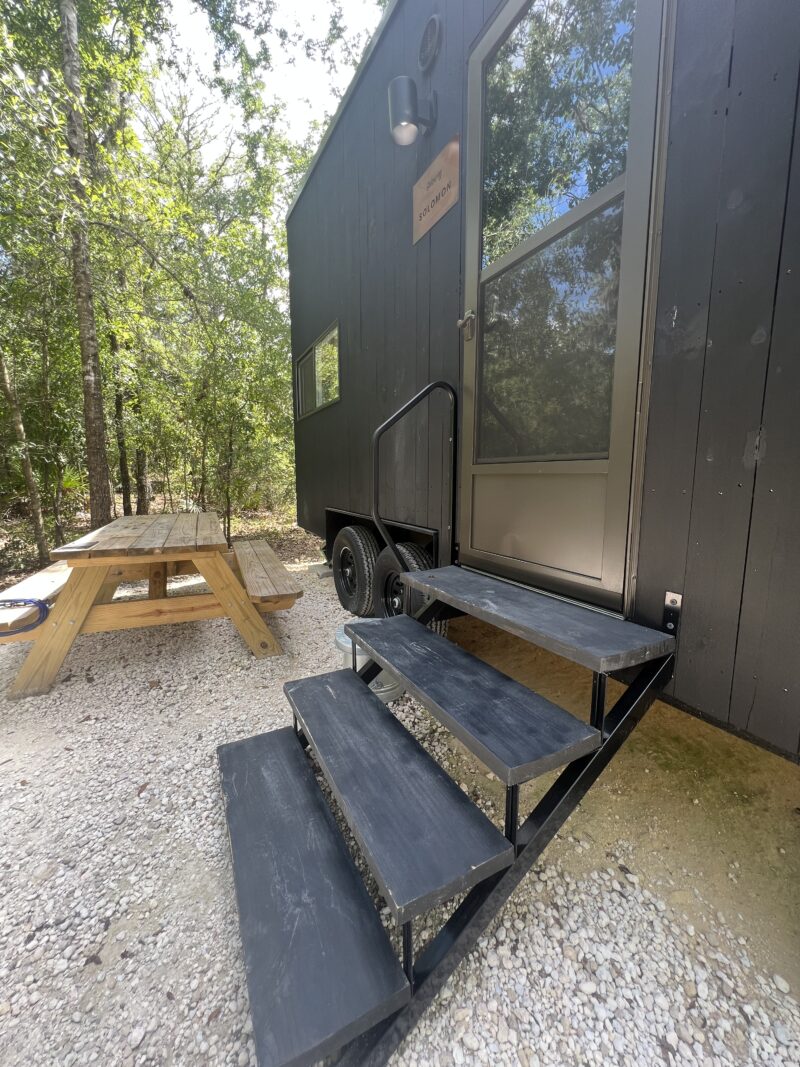
Magic Box units feature aerospace-grade aluminum and galvanized steel frames. This ensures the structure won’t warp or rot, which is a common failure point for traditional wood-built cabins in humid or coastal resort areas. Low maintenance costs directly translate to a healthier bottom line and a higher long-term ROI.
Case Study: How “Getaway” Scaled Using Modular Units
To see the true potential of manufactured tiny homes, one only needs to look at the American startup Getaway. Founded with the mission to help city dwellers disconnect, Getaway has scaled to over 28 locations across the United States. Their success is built entirely on the modular resort model.
The Getaway Formula: Instead of bespoke architecture for every location, they use standardized, factory-built units. This consistency allows them to predict their tiny home cost down to the penny, regardless of whether they are opening a site in the mountains of New Hampshire or the deserts of Texas.
- Operational Efficiency: By using standardized parts and layouts across all locations, their maintenance teams can work with maximum efficiency.
- Brand Consistency: A guest knows that a Getaway house in Austin will offer the same high-quality experience as one in Portland.
- Rapid Expansion: Getaway raised over $100 million in funding precisely because their prefab building model is “copy-paste” scalable. They can open a new 40-unit outpost in months, not years.
Conclusion: The Future of Hospitality is Modular
For the modern developer, the choice is clear. You can either struggle with the rising costs of lumber and labor in traditional construction, or you can embrace the efficiency of the prefab building movement. With a lower tiny home cost, faster deployment, and proven durability, manufactured tiny homes are the ultimate vehicle for hospitality ROI.
For more insights on how to start your own project, check out our Guide to Tiny House Zoning.